A rental application form is the first document a landlord asks a prospective tenant to complete. It collects the facts you need to compare applicants fairly: who they are, where they have lived, what they earn, who will live with them, and their permission for you to verify it all. The builder above makes a clean, printable rental application with the sections most landlords use, and lets you remove what you do not need.
How to make a rental application in 5 steps
- Add the property. Optionally type the address, rent, deposit, move-in date and application fee so they print on the form.
- Pick your state. Choose the property's state. Where we have verified the statute, the form prints the right fee and screening notice.
- Choose sections. Turn sections on or off: residences, employment, income, occupants, pets, vehicles, references and more.
- Write your criteria. Add your written screening criteria and up to five custom questions. We flag wording that may raise Fair Housing issues.
- Download the PDF. Download the rental application PDF, print it or email it. Each adult applicant fills in their own copy.
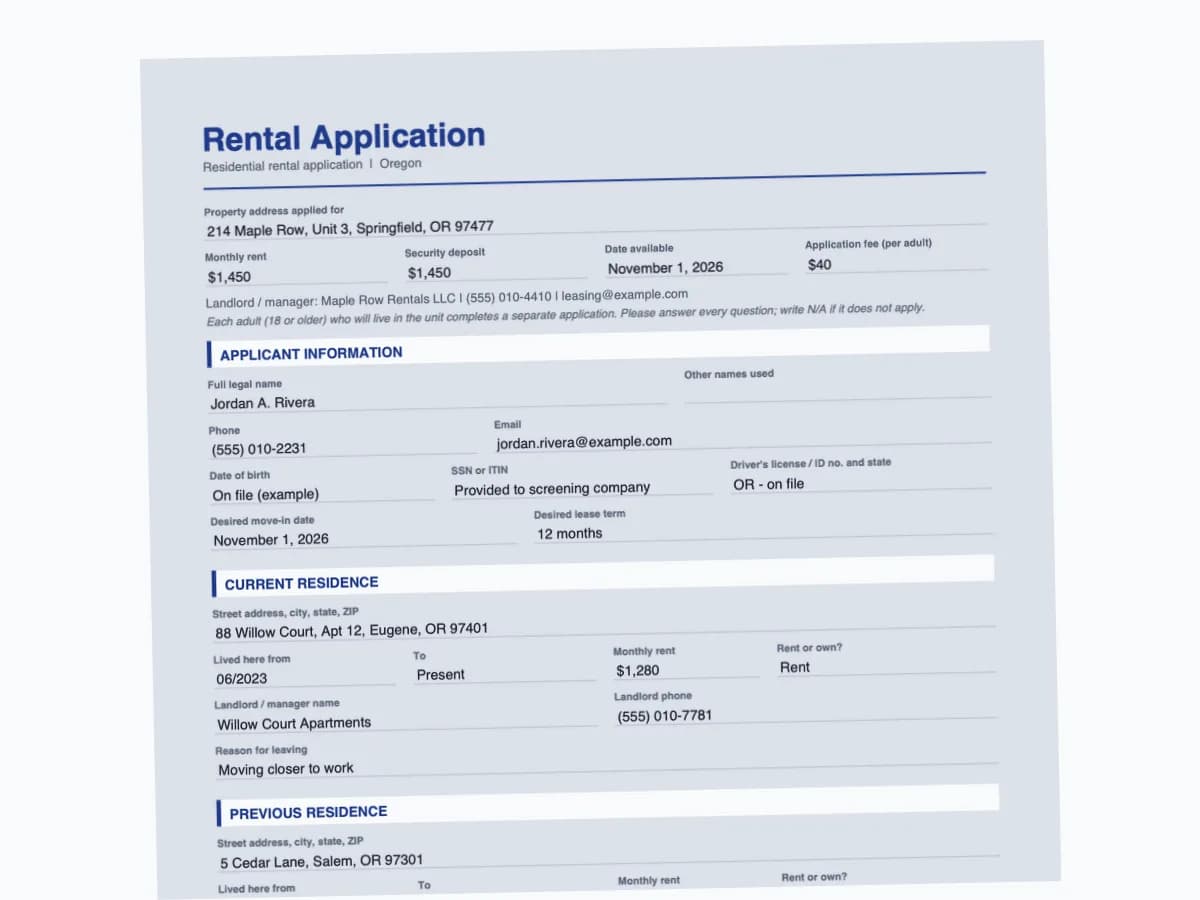
What to include in a rental application
| Section | Why landlords ask |
|---|---|
| Applicant information | Name, phone, email, and the screening identifiers a credit bureau needs (paper form only). |
| Residence history | Current and previous addresses and landlord contacts, so you can confirm on-time rent and how the home was left. |
| Employment and income | Employer, start date and gross monthly income, measured against a written income rule such as 2.5x or 3x the rent. |
| Other income | Benefits, support, vouchers or self-employment. Many states protect source of income, so count all lawful income the same way. |
| Occupants, pets, vehicles | Who will live there, animals (assistance animals are not pets) and parking needs. |
| Rental history questions | Past evictions, broken leases and smoking, with room to explain. |
| References and emergency contact | People who can speak to reliability, plus who to call in an emergency. |
| Authorization and signature | Written permission to verify the answers and obtain a consumer credit report and tenant screening report. |
Rental application fee rules by state
Application fees are where landlords most often trip up. Several states cap the amount or require written notices before you take it. Pick your state in the builder and the PDF prints the right notice. A few examples we verified on the official statute sites:
- New York: no application fee except a background and credit check at actual cost, up to $20, waived if the applicant brings a check from the past 30 days (Real Prop. Law § 238-a).
- California: actual costs only, under a $30 cap adjusted every year for inflation, with an itemized receipt and a copy of the credit report (Civ. Code § 1950.6).
- Virginia: up to $50 plus actual third-party background check costs (Code § 55.1-1203).
The full list, with Washington, Oregon, Minnesota and Maryland, is on our rental application laws by state page.
Fair Housing: keep your rental application compliant
The federal Fair Housing Act makes it illegal to refuse to rent, or to make any statement that indicates a preference, based on race, color, religion, sex, handicap, familial status or national origin (42 U.S.C. § 3604). Practical rules for a rental application:
- Use the same application and the same written criteria for every applicant, and review complete applications in order.
- Ask how many people will live in the unit, not whether they are married or have children.
- Treat assistance animals as a reasonable accommodation request, not as pets, and do not charge pet fees for them.
- Check state and city rules before asking about criminal history or refusing housing vouchers.
Our builder flags custom questions that may touch a protected class. Read the full Fair Housing rental application checklist.
Paper rental application or online application link?
A printed rental application works everywhere: hand it out at a showing or email the PDF. If you list online, an application link is faster for everyone. With Landlord Pro, applicants fill in the form on their phone without making an account, and you see a tidy summary and PDF for each one. We collect only the answers on the form, never Social Security numbers or bank details, and delete applications automatically after 7, 14 or 30 days. Compare Free and Pro.
Common rental application mistakes
- Charging a fee before a unit is actually available, or more than your state allows.
- Not writing down screening criteria, which makes decisions look arbitrary if challenged.
- Accepting a co-signer from one applicant but refusing another in the same situation.
- Leaving signed applications with SSNs in an unlocked drawer or an open inbox.
- Forgetting the adverse action notice when you deny someone based on a credit or screening report (15 U.S.C. § 1681m).
After you approve a tenant
Once your applicant is approved, put the terms in writing with a lease. Our sister site Lease Agreement Builder makes a free residential lease, and Rent Receipt Maker creates rent receipts for every payment after move-in.
Frequently asked questions
What should a rental application form include?
The applicant's name and contact details, current and previous addresses with landlord contacts, employer and income, other occupants, pets and vehicles, references, an emergency contact, the application fee, your screening criteria, a fair housing statement, and a signed authorization to verify the information and run a credit or background check.
Is this rental application really free?
Yes. The customizable PDF is free with no signup, no email and no trial that turns into a subscription. Landlord Pro ($39/year) is optional and adds an online application link, an applicant inbox, a fillable PDF and your logo.
Can I fill out a rental application online?
Applicants can print the PDF and fill it in by hand. With Landlord Pro you get a link tenants open on their phone; their answers arrive in your applicant inbox and are deleted automatically after 7, 14 or 30 days.
Does every adult need their own rental application?
Yes, that is standard practice. Each adult (18 or older) who will live in the unit completes and signs a separate application, so you can verify each person's income and history and so each person authorizes their own screening.
How much can a landlord charge for a rental application fee?
It depends on the state. New York allows only a background and credit check fee of up to $20 (Real Prop. Law § 238-a). Virginia caps the fee at $50 plus actual third-party check costs (§ 55.1-1203). California limits it to actual costs under a CPI-adjusted cap (Civ. Code § 1950.6). See our state page for details and citations.
Can I ask for a Social Security number on a rental application?
The paper form can include it because screening companies use it to match credit records, and you can turn it off. Our online application link never collects SSNs, dates of birth or bank numbers: those go directly to a screening company. If you collect them on paper, store the forms securely and shred them when you no longer need them.
What questions can't you ask on a rental application?
Do not ask about race, color, religion, sex, national origin, disability or familial status, which the Fair Housing Act protects (42 U.S.C. § 3604). Many states add source of income, age, marital status and more, and many cities limit criminal history questions. Ask every applicant the same questions.
Is a rental application a legally binding contract?
No. A rental application is a request to rent and an authorization to screen. The legally binding document is the lease. Once you approve an applicant, use a lease agreement, such as one from our sister site leaseagreementbuilder.com.
Last updated · Written and checked by the RentalApplicationMaker editorial team against official state statutes. A template, not legal advice.